
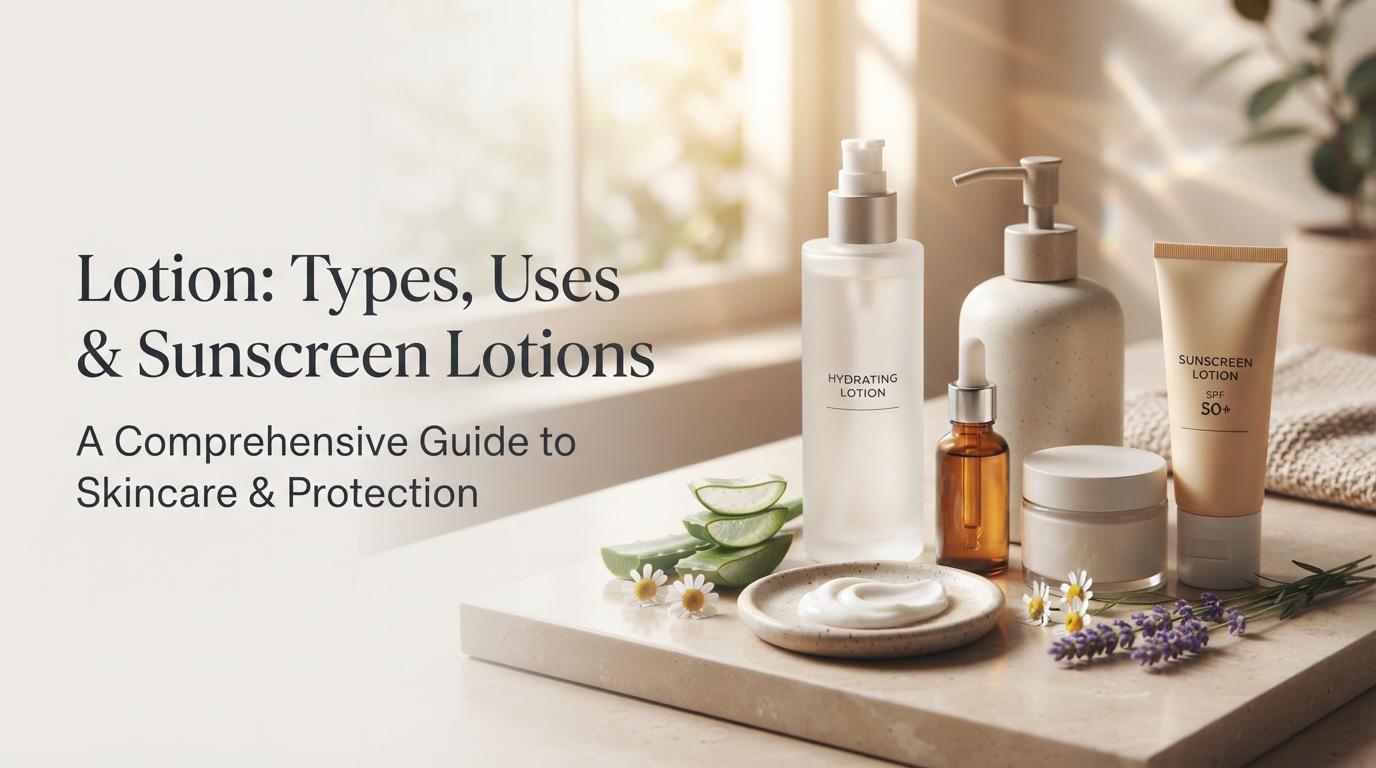
Lotions are topical preparations used for moisturizing, protecting, and treating the skin. They generally have a more fluid consistency than creams and ointments, making them convenient for application across relatively large areas of the body. Depending on their formulation and intended purpose, lotions may be used as cosmetic moisturizers, pharmaceutical preparations, skin protectants, and sunscreen products.
A lotion may contain water, oils, emollients, humectants, emulsifiers, preservatives, active pharmaceutical ingredients, or ultraviolet (UV) filters. The ingredients and their concentrations depend on whether the product is designed for hydration, symptom relief, treatment of a skin condition, or protection against environmental exposure.
Sunscreen lotions are one specialized category of lotions. They combine a liquid or semiliquid vehicle with sunscreen active ingredients designed to reduce the amount of ultraviolet radiation reaching the skin. However, not every lotion is a sunscreen, and not every sunscreen is formulated as a lotion.
What Is a Lotion?
A lotion is a topical preparation with a relatively fluid or semiliquid consistency intended for application to the skin. Lotions may be formulated as solutions, suspensions, emulsions, or combinations of these systems.
The term “lotion” does not describe one fixed chemical composition. Two products marketed as lotions may have substantially different ingredients, textures, purposes, and application instructions.
According to DermNet’s overview of topical formulations, lotions commonly contain a vehicle composed of ingredients such as water, oil, alcohol, preservatives, emulsifiers, and other formulation components. The exact definitions of lotions, creams, and related preparations can vary between manufacturers.
Lotions are often selected when a product needs to spread relatively easily across large areas of skin. However, the thickness and feel of a lotion depend on its formulation, and some products may be considerably richer than others.
How Lotions Are Formulated
A lotion’s formulation combines ingredients to produce a preparation with the required consistency, stability, spreadability, and performance. Formulators consider the properties of the active ingredients, intended application area, packaging, storage conditions, and compatibility between the components.
The principal formulation systems include solutions, suspensions, and emulsions.
Solutions
A solution contains one or more substances dissolved in a liquid vehicle. The vehicle may be predominantly water, alcohol, oil, or a combination of compatible solvents.
The dissolved ingredients are distributed throughout the liquid, although the stability of the preparation depends on factors such as solubility, temperature, pH, and interactions between ingredients.
Suspensions
A suspension contains finely divided solid particles dispersed throughout a liquid. The particles are not completely dissolved and may settle during storage.
Some medicated lotions contain suspended ingredients, including calamine or zinc oxide. These products may need to be shaken before use to redistribute the particles throughout the liquid.
The need to shake a lotion depends on the specific formulation and should be determined by the product’s instructions.
Emulsions
An emulsion combines two liquids that do not normally mix, such as oil and water. One liquid is dispersed as droplets within the other, while emulsifiers help maintain the stability of the mixture.
Oil-in-water emulsions are commonly used in skincare products because they can provide a relatively light texture. Water-in-oil emulsions contain a continuous oily phase and may provide a richer or more occlusive feel.
The stability of an emulsion depends on its emulsifier system, droplet size, viscosity, temperature, and other formulation factors.
Common Ingredients in Lotions
The ingredients used in lotions vary according to their intended function. A typical formulation may contain a vehicle, moisturizing agents, stabilizers, preservatives, and—in some cases—active ingredients.
Water
Water is a common ingredient in many lotions and may serve as the primary vehicle or continuous phase. It can dissolve water-soluble substances and contribute to the fluidity of the preparation.
Water-containing products require appropriate manufacturing and preservation controls because microbial contamination can affect product safety and stability.
Emollients
Emollients are ingredients that soften and smooth the skin. They can improve the skin’s surface feel and help reduce roughness.
Examples include certain oils, esters, fatty alcohols, and other lipid-based ingredients. The choice of emollient influences the texture, spreadability, and sensory characteristics of the lotion.
Humectants
Humectants attract and retain water. They are frequently used in moisturizing lotions to support hydration in the outermost layer of the skin.
Glycerin and propylene glycol are examples of ingredients used for humectant purposes. Their performance depends on their concentration, the other ingredients in the formulation, and environmental conditions.
Occlusive Ingredients
Occlusive ingredients help reduce water loss from the skin by forming a barrier or partially occlusive layer on its surface.
Petrolatum, oils, waxes, and other lipid-based materials can provide occlusive effects. Lotions containing these ingredients may leave a more persistent protective layer on the skin.
Emulsifiers
Emulsifiers help combine and stabilize oil and water phases in an emulsion. Their selection depends on the ingredients, desired texture, stability requirements, and manufacturing method.
Thickeners and Stabilizers
Thickeners increase viscosity and help control the consistency of a lotion. Stabilizers can help maintain the physical stability of emulsions and suspensions.
These components influence how easily a lotion flows from its container, spreads across the skin, and maintains a consistent texture during storage.
Preservatives
Water-containing preparations may support microbial growth if they are not adequately protected. Preservatives can help control microbial contamination and maintain product quality throughout its intended shelf life.
The appropriate preservative system depends on the formulation, packaging, manufacturing process, and applicable regulatory requirements.
Fragrances and Other Cosmetic Ingredients
Some lotions contain fragrances, colorants, botanical extracts, or other ingredients intended to affect their appearance or sensory properties.
These components are not present in every lotion. Individuals with known allergies or sensitive skin may need to review product labels and consider professional advice when selecting topical products.
Main Uses of Lotions
Lotions are used for cosmetic skincare, moisturizing, pharmaceutical applications, and skin protection.
Skin Moisturization
Moisturizing lotions are designed to improve the hydration and feel of the skin. They may combine humectants, emollients, and occlusive ingredients that support skin hydration through different mechanisms.
The effectiveness of a moisturizer depends on its formulation, the condition of the skin, the frequency of application, and environmental factors.
Cosmetic Skincare
Cosmetic lotions may be used on the face, hands, arms, legs, and other parts of the body. Their purposes can include improving softness, reducing the sensation of dryness, and supporting the appearance of the skin.
Facial and body lotions may differ in fragrance, texture, ingredient selection, and intended application area.
Pharmaceutical Applications
Some lotions are used as vehicles for active pharmaceutical ingredients intended for topical application. The formulation can influence how the active ingredient is distributed across the skin and how it interacts with the application site.
DermNet explains that the vehicle used in a topical preparation may be selected according to the skin condition, body site, and desired delivery of the active ingredient. Differences in formulation can affect the absorption and performance of topical medicines.
Medicated lotions should be used according to their instructions or the advice of a qualified healthcare professional.
Skin Protection
Certain lotions are formulated to help protect the skin from environmental exposure or irritation. Depending on the product, this may involve reducing moisture loss, creating a protective layer, or delivering ingredients intended to support the skin barrier.
The term “skin protectant” does not apply to every moisturizer. Protective claims depend on the product’s formulation, intended use, supporting evidence, and applicable regulations.
Sun Protection
Some lotions contain ultraviolet filters and are designed to protect the skin against solar radiation. These products are commonly known as sunscreen lotions.
Sunscreens can be formulated in different forms, including lotions, creams, gels, sticks, sprays, and powders. The U.S. Food and Drug Administration identifies lotion as one of the dosage forms used for legally marketed sunscreen products in the United States.
What Is a Sunscreen Lotion?
A sunscreen lotion is a topical lotion containing sunscreen active ingredients that reduce the amount of ultraviolet radiation reaching the skin.
The lotion serves as the delivery vehicle, helping distribute the sunscreen ingredients over the application area. Its other components may influence the product’s texture, spreadability, stability, and resistance to removal.
Sunscreen lotions may contain organic UV filters, inorganic UV filters, or a combination of different filters, depending on the formulation and regulatory market.
The performance of a sunscreen depends on the complete formulation and the testing performed to support its claims. The presence of a sunscreen ingredient alone does not establish the protection provided by the finished product.
How Sunscreen Lotions Protect the Skin
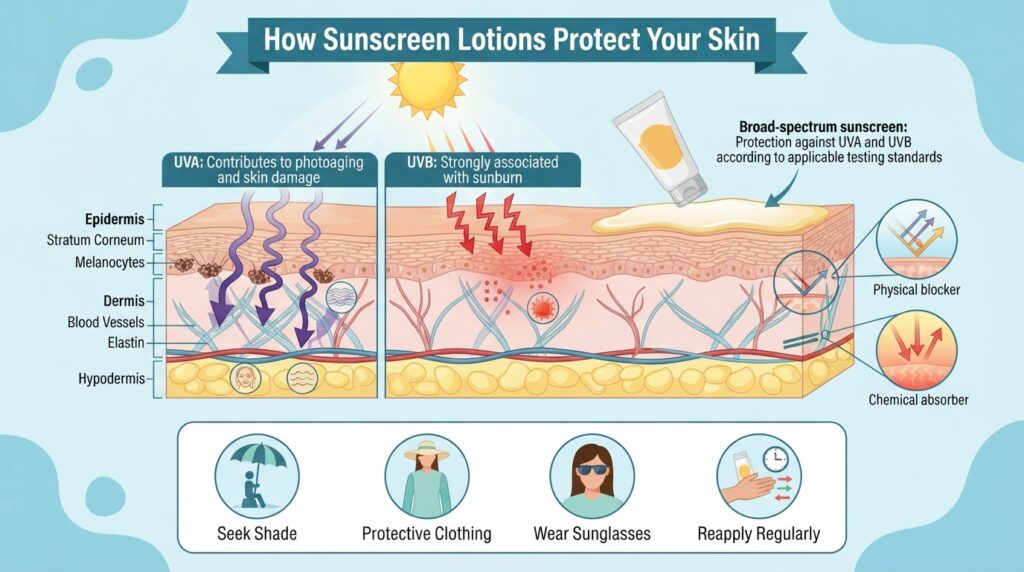
Ultraviolet radiation is a component of sunlight that can affect the skin and eyes. The ultraviolet spectrum is commonly divided into UVA, UVB, and UVC bands. The World Health Organization identifies UVA as radiation with wavelengths from 315 to 400 nanometres and UVB as radiation from 280 to 315 nanometres.
Most UVC radiation and a substantial portion of UVB radiation are absorbed by the atmosphere. The ultraviolet radiation that reaches Earth’s surface is predominantly UVA, along with a smaller UVB component.
Excessive UV exposure can contribute to sunburn, premature skin aging, skin cancer, and damage to the eyes. The WHO recommends combining sunscreen with other protective measures, including shade, protective clothing, hats, and sunglasses.
UVA Protection
UVA radiation penetrates more deeply into the skin than UVB radiation and contributes to photoaging and other forms of photodamage.
Broad-spectrum sunscreen products are designed to provide protection against both UVA and UVB radiation according to the testing and labeling requirements of the applicable jurisdiction.
UVB Protection
UVB radiation is strongly associated with sunburn. The sun protection factor, or SPF, is used to describe the level of protection against sunburn under standardized testing conditions.
SPF should not be interpreted as the number of hours a person can remain in the sun without risk. Sunscreen performance depends on the amount applied, coverage, reapplication, exposure conditions, and other factors.
SPF and Sunscreen Lotion Performance
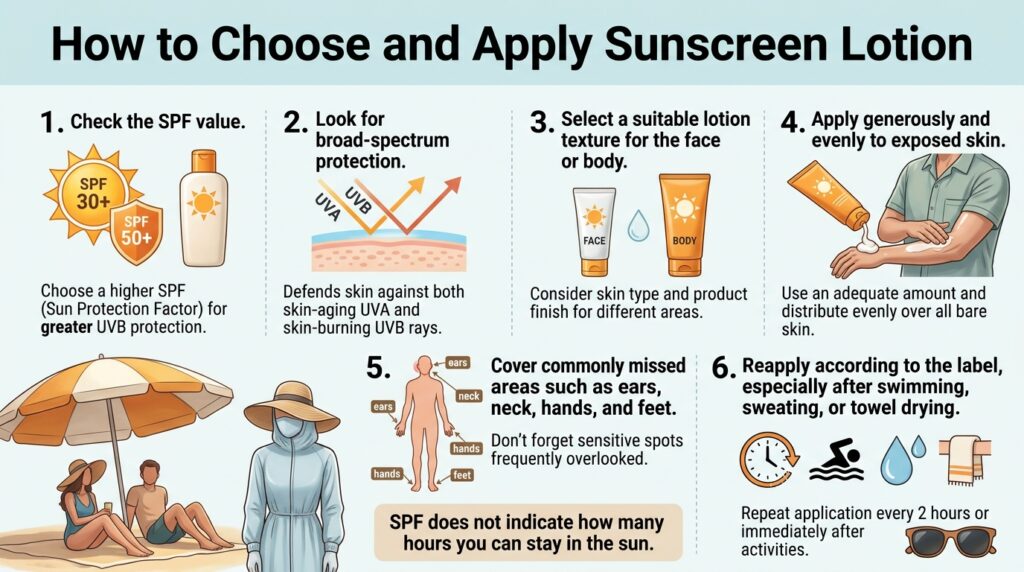
The sun protection factor is a standardized measure associated primarily with protection against sunburn. A higher SPF value generally indicates greater sunburn protection when the product is applied correctly under the conditions of testing.
SPF is not a direct measurement of protection against every wavelength of ultraviolet radiation. Consumers should also consider whether the product provides broad-spectrum protection.
The FDA recommends applying sunscreen liberally to exposed skin and reapplying at least every two hours, with more frequent application when swimming or sweating.
Sunscreen performance depends on factors such as:
- The amount of product applied.
- The uniformity of coverage.
- The areas of skin covered.
- Reapplication frequency.
- Swimming, sweating, and towel drying.
- The product’s water-resistance claims.
- The formulation’s interaction with the skin.
No sunscreen completely blocks ultraviolet radiation. Sunscreen should therefore be used alongside other sun-protection measures.
Broad-Spectrum Sunscreen Lotions
Broad-spectrum sunscreen products are designed to provide protection against both UVA and UVB radiation under the applicable regulatory requirements.
UVA and UVB protection are not interchangeable. SPF primarily describes sunburn protection, while broad-spectrum testing addresses protection across relevant ultraviolet wavelengths.
The exact definition and testing requirements for broad-spectrum labeling vary between jurisdictions. Consumers should review the product label and applicable local guidance.
The WHO recommends using broad-spectrum sunscreen on skin areas that cannot be adequately covered by clothing, while also seeking shade and using protective clothing.
Mineral and Organic Sunscreen Lotions
Sunscreen formulations are often described as mineral or organic, based on the types of UV-filtering ingredients they contain. Terminology and permitted ingredients vary between regulatory markets.
Mineral Sunscreen Lotions
Mineral sunscreen lotions commonly contain zinc oxide, titanium dioxide, or both.
These inorganic compounds interact with ultraviolet radiation through absorption and scattering. Their performance depends on factors such as particle properties, concentration, dispersion, and the formulation of the finished product.
Some mineral sunscreen formulations may leave a visible residue on the skin. Formulation techniques can affect the product’s appearance, spreadability, and cosmetic finish.
Organic Sunscreen Lotions
Organic sunscreen lotions contain carbon-based UV-filtering compounds that absorb specific portions of ultraviolet radiation.
Different organic filters absorb different wavelength ranges. Formulators may combine multiple filters to achieve the desired protection spectrum and meet regulatory requirements.
The permitted ingredients, concentration limits, and labeling requirements vary across countries.
Combination Formulations
Some sunscreen lotions combine mineral and organic UV filters. A combination approach may be used to achieve particular protection characteristics, texture, stability, or cosmetic properties.
The performance and regulatory status of a combination product depend on its complete formulation and the requirements of the market in which it is sold.
Sunscreen Lotion Versus Sunscreen Cream
Sunscreen lotions and creams both deliver UV-filtering ingredients to the skin, but their physical characteristics may differ.
Lotions are generally more fluid and may spread easily across large areas. Creams are typically thicker and may provide a richer texture or a more substantial skin feel.
The distinction is not absolute. Some lotions are relatively thick, and some creams have lightweight textures. The product’s performance depends on its formulation, application, and testing rather than its marketing name alone.
The most suitable format is one that allows the user to apply sufficient product evenly and consistently.
Sunscreen Lotion Versus Sunscreen Spray
Sunscreen lotions are generally applied directly to the skin using the hands or an applicator. This can make it easier to observe coverage and distribute the product across the intended area.
Sprays may be convenient for some uses, but they require careful application to avoid missed areas and unintended inhalation. Directions differ between products, and some spray formulations should not be applied directly to the face.
Regardless of format, sunscreen should be applied according to the product’s instructions.
Water Resistance in Sunscreen Lotions
Some sunscreen lotions are tested and labeled as water-resistant. This claim describes the period during which the product is expected to maintain its labeled sunburn protection under specified testing conditions during swimming or sweating.
Water resistance does not mean that a sunscreen is waterproof. Sunscreen can be removed or reduced by water, perspiration, abrasion, and towel drying.
The FDA states that sunscreen products should not be described as waterproof and advises consumers to follow the product’s reapplication instructions after swimming or sweating.
How to Apply Sunscreen Lotion
Correct application is important because insufficient or uneven coverage can reduce the protection achieved.
General application considerations include:
- Apply the sunscreen generously to exposed skin according to the product’s directions.
- Spread the product evenly over the areas requiring protection.
- Cover commonly missed areas, including the ears, neck, tops of the feet, and backs of the hands.
- Follow the product’s instructions regarding when to apply it before sun exposure.
- Reapply according to the label, particularly after swimming, sweating, or towel drying.
- Use additional protective measures such as shade, protective clothing, hats, and sunglasses.
The FDA notes that an average-sized adult or child generally needs at least one ounce of sunscreen to cover the body evenly. The required amount can vary according to body size and the area being covered.
Sunscreen Lotion and Skin Type
Sunscreen lotions are available in formulations designed for different skin characteristics and preferences. However, labels such as “for sensitive skin” or “for oily skin” do not guarantee that a product will suit every person.
Oily Skin
People with oily skin may prefer lightweight or less occlusive formulations. Some products are marketed as non-comedogenic or designed to reduce a greasy sensation.
These claims depend on the product’s formulation and supporting evidence. Individual responses can vary.
Dry Skin
People with dry skin may prefer sunscreen lotions containing moisturizing ingredients such as humectants, emollients, or occlusive materials.
The most suitable product depends on the cause and severity of dryness, the application area, and individual tolerance.
Sensitive Skin
People with sensitive skin may prefer products with fewer potential irritants. However, sensitivity varies between individuals.
Fragrances, preservatives, botanical extracts, and certain sunscreen ingredients can cause irritation or allergic reactions in susceptible people.
Individuals who experience persistent or severe reactions should discontinue use of the suspected product and seek appropriate medical advice.
Acne-Prone Skin
People with acne-prone skin may prefer sunscreen products labeled non-comedogenic or formulated to feel lightweight. These labels are not guarantees that a product will not cause breakouts in every individual.
Sunscreen remains an important part of skin protection, including for people who use treatments that may increase photosensitivity.
Sunscreen Lotion for the Face and Body
Facial and body sunscreen lotions may differ in their texture, fragrance, ingredient combinations, and intended use.
Facial products may be designed to reduce shine, minimize visible residue, work under makeup, or provide a particular cosmetic finish. Body products may prioritize easy spreading over larger areas.
A product intended for the body should not automatically be assumed to be appropriate for the face. Users should review the label, application directions, fragrance, and ingredient profile.
Products should be kept away from the eyes unless they are specifically intended for that application.
Lotions for Children
Children require appropriate protection from excessive ultraviolet exposure. Sunscreen is one component of sun protection, alongside shade, protective clothing, hats, and avoiding unnecessary exposure.
The FDA advises consulting a healthcare professional before applying sunscreen to infants younger than six months. Caregivers should follow age-specific product directions and relevant medical guidance.
For older children, sunscreen should be applied to exposed areas according to the label. Care should be taken to avoid contact with the eyes and accidental ingestion.
Sunscreen Lotion and Expiration
Sunscreen products may lose stability or fail to meet their labeled performance after expiration or improper storage.
Consumers should follow the storage instructions and avoid using products that have passed their expiration date. Changes in color, odor, texture, or separation may indicate deterioration, although appearance alone cannot establish whether a product remains effective.
Sunscreen should be protected from excessive heat and direct sunlight when recommended by the manufacturer.
Possible Skin Reactions to Lotions
Topical lotions can cause irritation or allergic reactions in susceptible individuals. Possible reactions include:
- Redness.
- Burning or stinging.
- Itching.
- Dryness.
- Rash.
- Contact dermatitis.
- Eye irritation.
Reactions may result from an active ingredient, fragrance, preservative, solvent, or another component of the formulation.
People who experience persistent, severe, or worsening reactions should stop using the suspected product and seek appropriate medical advice. Symptoms such as facial swelling or difficulty breathing require urgent medical attention.
Storage and Product Stability
Proper storage helps preserve the quality and performance of a lotion. Storage requirements depend on the formulation, packaging, and manufacturer’s stability testing.
Common considerations include:
- Keeping the container closed when not in use.
- Avoiding temperatures outside the recommended range.
- Protecting the product from excessive heat when instructed.
- Preventing contamination.
- Following the expiration date and usage directions.
Repeated exposure to air, water, dirty hands, or unsuitable storage conditions can affect certain formulations.
Regulatory Classification of Lotions
The regulatory classification of a lotion depends on its intended use, ingredients, claims, and the laws of the country where it is marketed.
A lotion marketed primarily to moisturize or improve the appearance of the skin may be regulated as a cosmetic in some jurisdictions. Products intended to treat or prevent disease, affect the structure or function of the body, or provide a regulated protective effect may be subject to additional requirements.
Sunscreens are regulated differently around the world. In the United States, sunscreen products are generally regulated as over-the-counter drugs. Products with both cosmetic and drug purposes may be subject to requirements associated with both categories.
Regulatory status cannot be determined solely by a product’s consistency or whether it is described as a lotion.
How to Choose a Lotion
The appropriate lotion depends on its intended purpose, application area, skin characteristics, and product instructions.
Consider the following factors:
Intended Purpose
Determine whether the product is intended for moisturizing, cosmetic care, pharmaceutical treatment, skin protection, or sun protection.
A standard moisturizer should not be assumed to provide UV protection unless it is specifically labeled and tested as a sunscreen.
Ingredients
Review the ingredient list for known allergens, fragrances, active ingredients, and components that may be unsuitable for your skin.
People with a diagnosed skin condition or history of allergic reactions may benefit from professional guidance.
Texture and Spreadability
A lotion should be practical to apply across the intended area. A product that spreads comfortably may be easier to use consistently.
For sunscreen, ease of application is particularly important because inadequate coverage can reduce the protection obtained.
Protection Claims
When choosing sunscreen, review the SPF value, broad-spectrum claim, water-resistance information, and directions for application and reapplication.
Claims should be interpreted according to the regulatory standards applicable to the product’s market.
Packaging
Packaging affects convenience, hygiene, portability, and product stability. Pumps, tubes, bottles, and other containers may be selected according to the lotion’s viscosity and intended use.
The container should be used according to its instructions to reduce contamination and preserve the product.
Frequently Asked Questions
Is every lotion a moisturizer?
No. Many lotions are designed to moisturize the skin, but lotions can also be formulated as pharmaceutical preparations, skin protectants, suspensions, and sunscreen products.
Is sunscreen lotion the same as regular lotion?
No. Sunscreen lotion contains UV-filtering active ingredients and is intended to provide protection against ultraviolet radiation. A regular moisturizing lotion does not necessarily provide sunscreen protection.
Is lotion thinner than cream?
Lotions are generally more fluid than creams, but the distinction depends on the formulation. Some lotions can be relatively thick, while some creams have lightweight textures.
Why do some lotions need to be shaken?
Some lotions contain suspended particles that can settle during storage. Shaking helps redistribute those particles so the product can be applied more uniformly.
Can sunscreen lotion moisturize the skin?
Some sunscreen lotions contain moisturizing ingredients and may improve the skin’s hydration or feel. Moisturizing performance varies by formulation and should not be assumed for every sunscreen product.
Does a higher SPF mean sunscreen can be applied less often?
No. SPF does not determine how long a person can safely remain in the sun. Sunscreen should be reapplied according to the product’s instructions and after activities such as swimming, sweating, or towel drying.
Are mineral sunscreen lotions safer than organic sunscreen lotions?
Safety cannot be determined solely by whether a sunscreen uses mineral or organic filters. The complete formulation, concentration, application method, regulatory requirements, and individual circumstances are relevant.
Can lotions cause skin irritation?
Yes. Some people may experience irritation or allergic reactions to lotion ingredients. Fragrances, preservatives, active ingredients, and other components can contribute to reactions in susceptible individuals.
Can lotion be used on the face?
Some lotions are formulated for facial use, while others are intended for the body or specific areas. Review the product’s directions and consider its ingredients, texture, and intended application area.
Conclusion
Lotions are versatile topical preparations used in cosmetic skincare, pharmaceutical products, skin protection, and sun protection. Their relatively fluid consistency often makes them convenient for application over large areas, although their texture and performance depend on the formulation.
Sunscreen lotions are a specialized category that combines a lotion vehicle with ultraviolet-filtering active ingredients. Their effectiveness depends on the complete formulation, testing, application amount, coverage, and reapplication practices.
Understanding the differences between lotions, creams, ointments, and other topical preparations helps consumers select products according to their intended use. For sunscreen lotions, broad-spectrum protection, appropriate application, label instructions, and additional sun-protection measures are important considerations.
References
- U.S. Food and Drug Administration — Tips to Stay Safe in the Sun: From Sunscreen to Sunglasses
- World Health Organization — Ultraviolet Radiation
- World Health Organization — Radiation: Protecting Against Skin Cancer
- DermNet — Topical Formulations

I’m James Wilson, and I’ve always believed that the best skincare advice comes from research, real-world experience, and honest recommendations—not marketing claims. Over the years, I developed a strong interest in understanding how sunscreens work, comparing ingredients, SPF ratings, and formulas to find products that truly protect the skin.
Through SunscreensInsider.com, I share in-depth sunscreen buying guides, product reviews, and practical advice to help readers choose the right sun protection for their skin type, lifestyle, and budget. Every recommendation is backed by careful research, ingredient analysis, expert insights, and real user experiences whenever possible. My goal is simple: to make sunscreen shopping easier by providing clear, unbiased information that helps people protect their skin with confidence.